Kebaya, Indonesia Cultural Heritage

Indonesia has a cultural heritage that is priceless. With ethnic diversity that exists and each has its own customs, making Indonesia a diverse work culture. One of them, such as kebaya.

Sanur Beach Bali

Sanur Beach is a place of wayfaring famous tourist island of Bali. This place is located just east of Denpasar, the capital of Bali. Sanur located in the Municipality of Denpasar.

Sasando Rote

Once upon a time, there was a boy named Sangguana who lived in Rote Island. One day, he tended to savannah. Felt tired and asleep, he slept under a palmyra tree. That’s when the dream came.

Arts Debus From Banten

Debus is a martial art from Banten. This art was created in the 16th century, in the reign of Sultan Maulana Hasanuddin (1532-1570). Debus, an art which demonstrates the remarkable human ability, immune to sharp weapons, fire resistant.

Hanging Stone and Origin of Parapat City

In one remote village on the outskirts of Lake Toba in North Sumatra, there lived a husband and wife with a beautiful daughter named Chrysanthemum.In addition to beautiful, Chrysanthemum is also very diligent in helping parents work in the fields.

Rabu, 09 Maret 2011

Gamelan

Gamelan is a musical ensemble that usually highlight metallophone, xylophone, drums, and gongs. The term gamelan refers to the instrument / tool, which constitute an integral whole which is realized and sounded together. Gamelan word itself comes from the Javanese gamel which means hitting / beating, followed by a suffix that makes the noun. Gamelan orchestra mostly found in Java, Madura, Bali, and Lombok in Indonesia in various sizes and shapes ensemble. In Bali and Lombok today, and in Java through the 18th century, the term gong is considered synonymous with gamelan. 


Occurrences gamelan preceded by Hindu-Buddhist culture that dominated Indonesia in the early days of recording history, which also represents the original art of Indonesia. Instrument developed to shape up like this in the days of the Majapahit Kingdom. In contrast with Indian music, the only impact of the India-an in gamelan music is how to sing it. In Javanese mythology, the gamelan was created by Sang Hyang Guru in Saka Era, the god who controls all the land of Java, with palaces on the mountain Mahendra in Medangkamulan (now Mount Lawu). Sang Hyang Guru first created gong to summon the gods. For a more specific message and then create two gongs, and eventually formed set of gamelan. 
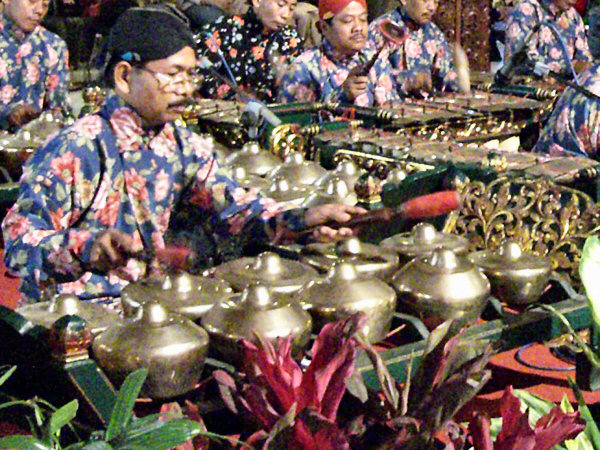

The description of the first ensemble of musical instruments discovered at the Borobudur Temple, Magelang, Central Java, which has stood since the 8th century. Musical instruments such as bamboo flutes, bells, kendhang in various sizes, harp, stringed musical instrument that swiped and learned, is found in the relief. However, little is found elements of metal musical instruments. However, relief of the instrument is said to be the origin of the gamelan. 

Gamelan orchestra tuning and making is a complex process. Gamelan tuning using four ways, namely slendro, pelog, "Degung" (special area of Sunda, or West Java), and "madenda" (also known as the diatonic, the same as the original minor scale that is widely used in Europe. 
Gamelan music is a combination of foreign artistic influence that diverse. Linkages to note the tone of the Chinese, the musical instruments of Southeast Asia, drum band and move to music from India, bowed strings from the Middle East region, Europe and even the military style that we hear the traditional music of Java and Bali today. 

The interaction component is loaded with melody, rhythm and sound color to maintain the glory of the Balinese gamelan orchestra music. The pillars of this music brings together a variety of Balinese rural community character that became the order of the typical music that is an inseparable part of everyday life.
Selasa, 08 Maret 2011

Sumatran Orangutan

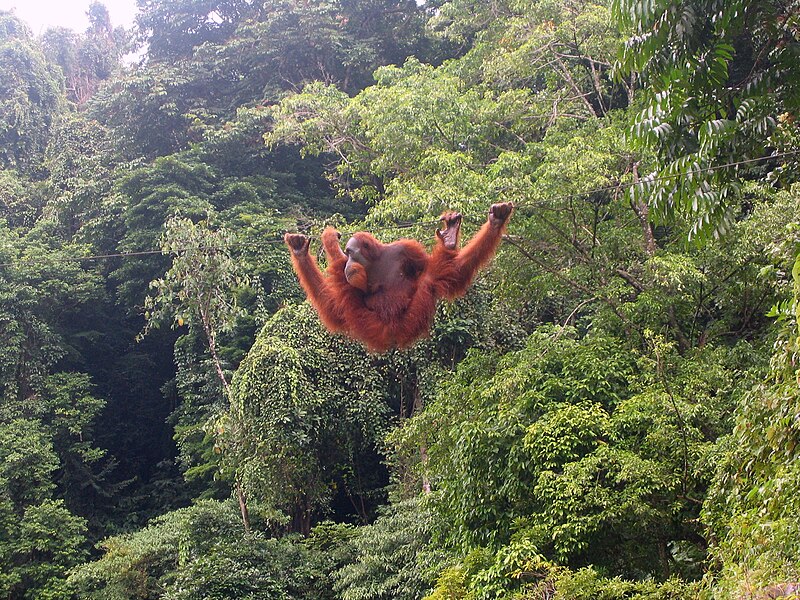
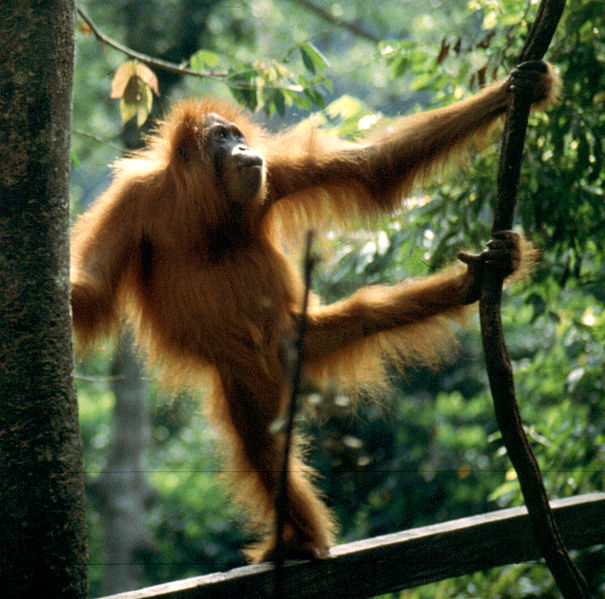
Sumatran orangutan (Pongo abelii) is the rarest species of orangutan. Sumatran orangutans live and endemic to Sumatra, an island located in Indonesia. They are smaller than the orangutans of Borneo. Sumatran orangutans have about 4.6 feet tall and weighs 200 pounds. Females are smaller, with 3 feet tall and weighs 100 pounds. 


Compared Borneo Orangutan, Sumatran orangutan prefers feed mainly fruits and insects as well. The preferred fruit including fruit banyan and jackfruit. They also eat bird eggs and small vertebrates. Sumatran Orangutan shorter in the feed at the stem of a tree. 

Wild Sumatran orangutans in the swamp Suaq Balimbing observed using tools. A tree branch broke orangutans whose length is about one foot, pushing aside the branches and sharpen edges. Then he uses it to poke holes trunk tree to look for termites. They also use sticks to banging on the walls of the hive. Also, orangutans also use tools to eat fruit. When Neesia tree ripe fruit, fruit is hard, ridged skin softened until it fell open. Inside is the preferred seed of the orangutan, but their hair covered with glass fiber-like illness when ingested. Orangutan Neesia eaters will select five inch rod, skinned and then remove the feathers with it. When the fruit is clean, the monkey will eat the seeds using a rod, or fingers. Although similar swamp in Kalimantan, Borneo orangutans wild has not been seen using a tool like this. 


Sumatran orangutan NHNZ filmed for her show Wild Asia: In the Realm of the Red Ape, the show demonstrates one of the orangutans using simple equipment, twigs, to reach food from difficult places. There is also a series of images of an animal using the leaf as an umbrella during a rain storm tropical 
Sumatran Orangutan also prefer to dwell in the tree than his cousin from Borneo; this is probably because of predators such as the Sumatran tiger. They move from tree to tree using a swinging arm. 

Life cycle 
Sumatran orangutans are more social than the orangutans of Borneo. Orangutans are gathered to eat large amounts of fruit in a banyan tree. However, adult male orangutans generally avoid contact with other adult males. Rape is common among orangutans. Sub-adult males will try to mate with any female, although maybe they fail because adult females impregnated easily refuse. Adult female orangutans prefer to mate with adult males average birth period longer than the Sumatran orangutan orangutans of Borneo and is the longest average period of great apes. Sumatran orangutans give birth when they were aged about 15 years. Baby orangutans will be close to its parent to three years. Even after that, her son would still be associated with its parent. The two species of orangutans may live several decades; approximate length can exceed 50 years old. Average first breeding P. abelii is about 12.3 years without any sign of menopause. 

Endemic Sumatran orangutan from Sumatra island and his life is limited in the north of the island. In the wild, Sumatran orangutans survive in the province of Nanggroe Aceh Darussalam (NAD), the northernmost tip of Sumatra. Primates are used to spread more widely, as they found more to the South in the 1800s as in Jambi and Padang. There is a small population in North Sumatra province along the border with NAD, especially in the forests of Lake Toba. Surveys in the Lake Toba only found two areas of habitat, Bukit Lawang (defined as a wildlife preserve) and Gunung Leuser National Park. In 2002, the World Conservation Union placed the species in the IUCN Red List with critical status. 


Recent surveys estimate there are about 7300 Sumatran orangutans surviving in the wild. Some of them are protected in five districts in the Gunung Leuser National Park and others living in areas not protected: Aceh blocks northwest and northeast, the river Batang Toru West, East and Sidiangkat Sarulla. Breeding program was created in the Thirty Hill National Park in Jambi and Riau provinces, and generate a new population of Sumatran orangutans.

The Maimun Palace in Medan

Some say, hasn't been to Medan if not, enjoy the charm of the Maimun Palace . Icons of Medan which implies the rest of the Malay Sultanate of Deli splendor was fascinated with the various types of architecture but still thick Malay nuanced. Brig is located at Jalan Katamso, Maimun Palace can be reached just 30 minutes from the Polonia Airport and an hour from the Port of Belawan, Medan, North Sumatra. 

The Maimun Palace

From a distance, we will feel the strong appeal of the buildings on the land area of 2700 square meters was established since 1888. Yellow color were scattered in 100 years the palace was once the administrative center of the Deli Sultanate. Understandably, the yellow color is typical Malay. 

Maimun Palace Building was unique with a blend of Moghul architecture, the Middle East, Spain, India, Netherlands, and Malay. Dutch influence appears in the form of doors and windows are wide and high. Islamic influence seen on the roof of the arch we often see on buildings in the Middle East, India and Turkey. In a way, this blend of East and West without losing Malay traits that appear on the palace walls made of wood. 

The Maimun Palace

Maimun palace consists of three main spaces. Namely, the main building, right wing and left wing. The main building area of 412 square meters it is often called the hall. That's where the royal throne is located. The throne is still used in certain occasions, especially during the coronation of the king or the royal family worship in the days of Islam. What is unique here is the traditional meeting room. The room that we still use today for a meeting with the Sultan of Deli. Malay people call it Lift Worship to the Sultan. 

Furniture palace radiates European influence. It looks at the chandeliers were imported from France as well as chairs, tables, and cabinets imported from Holland. In addition to furniture, some building materials were imported from Europe. For example, marble tiles. Many say, European style is closely related to the palace architect, Captain TH Van ERP, the Dutch nationality. Inside the palace, there are 25 rooms with unique interior design that shows a mix of art from various countries. Marble used in court is different in each room. 

European style that contrasts with the typical style buildings Karo outdoors. According Moharshyah, it relates to the origin of the Sultan of Deli I who married the daughter of the Kingdom Sunggal. Sultan considered Kalimbubu. Each activity must involve the community Karo sultanate. 

Only 200 meters from the Palace Maimun, we will find the Masjid Raya Al Mahsum, no less majestic in Jalan SM Raja Medan. The masjid on the land area of five hectares of the Sultanate of Deli started to be built on the leadership of Sultan Mamun Al Rashid Perkasa Alam IX on August 21, 1906. 

The Grand Masjid Al - Mahsum

The mosque which construction spend 500 thousand guilders was opened to the public starting September 10, 1909. Now, in the age of more than a century, the building was still seem exotic. Grandeur of the masjid is part and parcel of the history of the greatness of the Deli Sultanate. 

The distance is only 200 meters from the Palace Maimun indicate that. To get closer to local people, the Sultanate of Deli Socializing with each Ramadhan Iftar event at Masjid Raya Al Mahsum by presenting the typical spicy Malay porridge. Apparently, there is increasing demand from time to time. Sultanate of Deli cooks up spicy difficult to meet the needs of traps to break the fast together. 

Finally, after maintaining pulp spicy dish up to 50 years, the Sultanate of Deli leave it to cook to the Nazarite masjid. The problem, is not easy to cook porridge hot. In addition to requiring a variety of spices, cooking quite a long process. The approval of the Deli Sultanate, the board decided to replace the masjid with a spicy porridge porridge soup which is also typical Melayu Deli. The reason is not as complicated as making hot porridge. Also, although more simple marinade ingredients, it's no less delicious. "Serving soup porridge was still continues today. 

Unfortunately, that magnificent building started to seem less maintenance. Some appear broken glass. Some parts of the roof is leaking when the rain is torrential. An increasingly large number of pilgrims is also not balanced with ablution water points is greater.

Senin, 07 Maret 2011

North Sumatra

North Sumatra is one of Indonesia's last surfing frontiers. "North Sumatra" consists of 5 islands or island groups: Hinako Islands, Nias, Telos and 2 other obscure island groups to the north. North Sumatra receives similar swell to Mentawais and enjoys its peak swell season from May to September. Despite Indonesia's reputation for hollow lefts, in North Sumatra right-handers are slightly more prevalent. While Lagundri Bay at Nias has been surfed for decades, it is the more obscure rights like Bawa (a Sunset-like right bowl that holds up to 15 feet) and Treasure Island (a long, hollow, mechanical right peeling for 200 meters) that have attracted the attention of late. Throw a mix of hollow and bowl lefthanders into the picture like Asu, Afulu, the Machine, and many more obscure rights and lefts.

Pedicab Transportation in Medan

In contrast to the small island of Bali, North Sumatra province is large with one of the biggest lakes in the world, Toba Lake, at its navel. The continuous mountain of Bukit Barisan, which extends from Aceh at the tip of Sumatra island to Lampung at the bottom of the island, guards the province on the west side, providing home for thick, tropical jungles and lush vegetations. As you go down the western mountains towards the beaches of the east, mountain streams, strong rivers, and gorgeous waterfalls will accompany you.

Batak woman with traditional dress

Along the length of this province crosses Bukit Barisan Mountains with peaks of numerous volcanoes. The land has thick virgin forests, lush vegetation, rice fields, mountain streams, rivers, waterfalls and sandy beaches. It has a rich flora and fauna. An abundance of birds, butterflies, buffaloes, deer, mouse deer, orangutans and many other export commodities make North Sumatra one of the richest provinces in Indonesia, as it produces more than 30 % of Indonesia's exports. The province offers the visitors, especially nature lovers, beautiful tropical panoramas, terraced rice fields, blue mountains, jungle covered hills, white sandy beaches, music, dance and folk arts.

Jumat, 04 Maret 2011

Nanggroe Aceh Darussalam

Aceh which was previously known by the name of the Special Region of Aceh (1959-2001) and Nanggroe Aceh Darussalam (2001-2009) is the westernmost province in Indonesia. Aceh has the autonomy to set its own, unlike most other provinces in Indonesia, for historical reasons. This area is bordered by the Bay of Bengal in the north, the Indian Ocean to the west, the Strait of Malacca in the east, and North Sumatra in southeast and south.


Aceh Map

The capital of Aceh is Banda Aceh. Its port is Malahayati-Krueng Raya, Ulee Lheue, Sabang, Lhokseumawe and Langsa. Aceh is the region worst hit by the earthquake and tsunami of 26 December 2004. Some places on the coast disappear altogether. The hardest is Banda Aceh, Aceh Besar, Aceh Jaya, Aceh Barat, Singkil and Simeulue.


Aceh has a wealth of natural resources such as petroleum and natural gas. Natural Resources is located in North Aceh and East Aceh. Aceh is also famous for its forest resources, which is located along the Bukit Barisan range, from Kutacane, Aceh Tenggara, Seulawah, Aceh Besar, until Ulu Masen in Aceh Jaya. A national park, namely Mount Leuser National Park  is also available in the Southeast Aceh.

Baiturrahman Masjid

History
In the days of the Sultan Iskandar Muda Meukuta Perkasa Alam, Aceh is a country very rich and prosperous. According to a French explorer who arrived in Aceh in the heyday of the era, the power reaching the west coast of Aceh, Minangkabau up to Silver. Sultanate of Aceh have established relationships with the kingdoms of the West in the 16th century, including Britain, the Ottomans, and the Netherlands.


Aceh Sultanate involved a prolonged power struggle since the beginning of the 16th century, first by Portugal, and since the 18th century with the United Kingdom (UK) and the Netherlands. At the end of the 18th century, Aceh was forced to hand over territory in Kedah and Pulau Pinang in Malay Peninsula to Great Britain.

Saman Dance

In 1824, the British-Dutch Agreement was signed, in which Britain handed over its territory on Sumatra to the Dutch. Britain Party claim that Aceh was their colony, although this is not true. In 1871, Britain allowed the Dutch to colonize Aceh, possibly to prevent France from gaining power in the region.


Arts and Culture
Aceh is a region that is rich with culture and art rule looks other parts of Indonesia. Aceh has a distinctive variety of cultural arts such as dance, and other cultures such as: 
  • Didong (performing arts from the public Gayo) 
  • Meuseukee Eungkot (a tradition in the area of West Aceh) 
  • Peusijuek (or plain flour in the tradition of Malay) 
Literature 
  • Bustanussalatin 
  • Hikayat Prang Sabi 
  • Hikayat Malem Diwa 
  • Legend Amat Rhah Manyang 
  • Legend Putroe Neng 
  • Legend Magasang and Magaseueng 
Traditional Weapons 
Rencong is the traditional weapon of Aceh, its shape resembles the letter L, and if you look closer its shape was writing bismillah calligraphy. Rencong included in the category of dagger or knife (not a knife or sword). 
Besides rencong, the nation of Aceh also has several other unique weapons, such as siwah, geuliwang and peudeueng. 

Rencong the traditional weapon of Aceh

Traditional House 
Acehnese traditional house called Rumoh Aceh. The traditional house-type house on stilts with 3 main parts and an additional section. Three main parts of Aceh is home Seuramoe keuë (front porch), Seuramoe Teungoh (porch middle) and Seuramoe likôt (back porch). Meanwhile, an additional section that is rumoh dapu (home kitchen).

Aceh House

Dance 
Aceh province has at least 10 ethnic groups, has a wealth of dance very much and also very impressive. Some famous dances at the national level and even the world is a dance that originated from Aceh, such as Dance Rateb Meuseukat and Saman.